
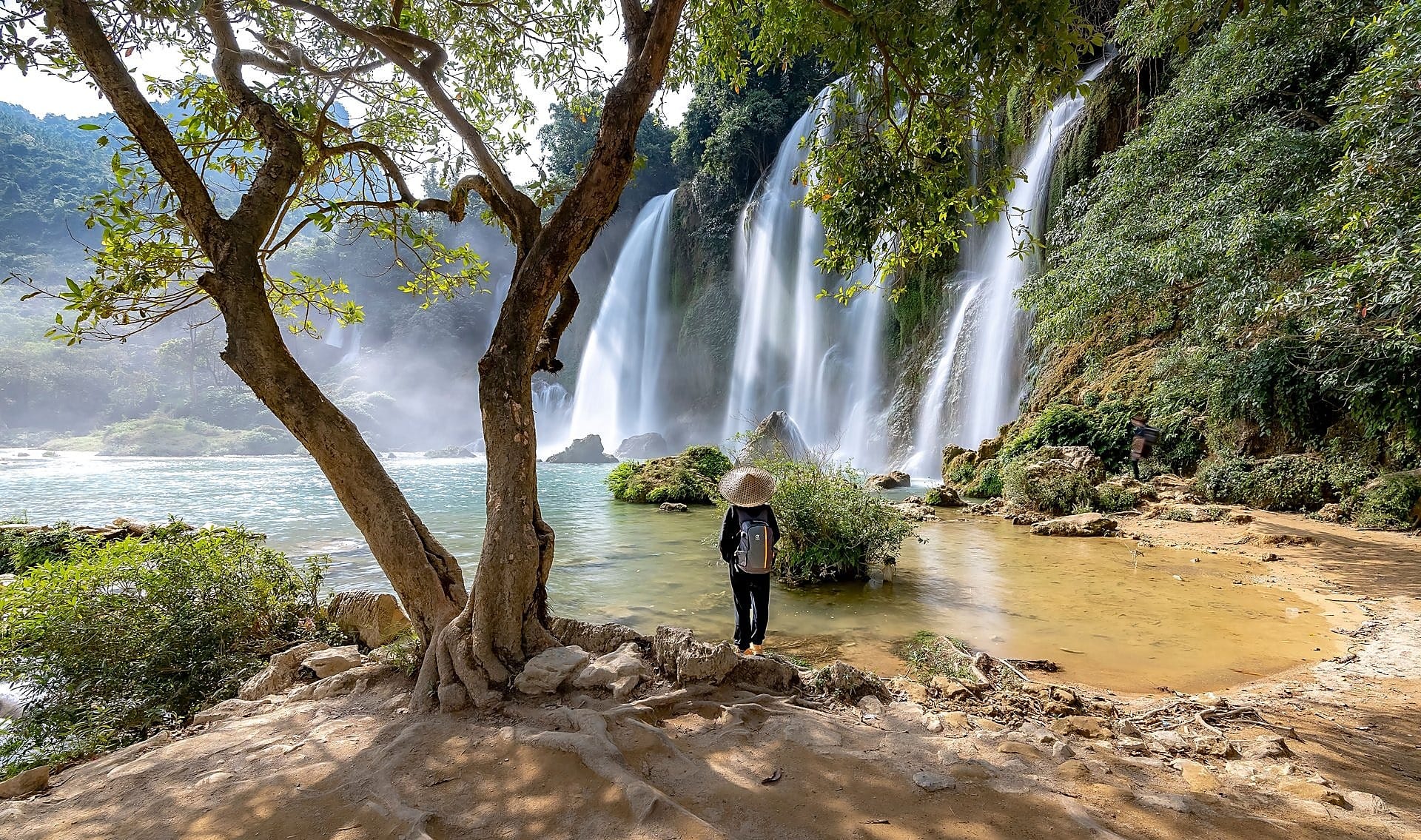
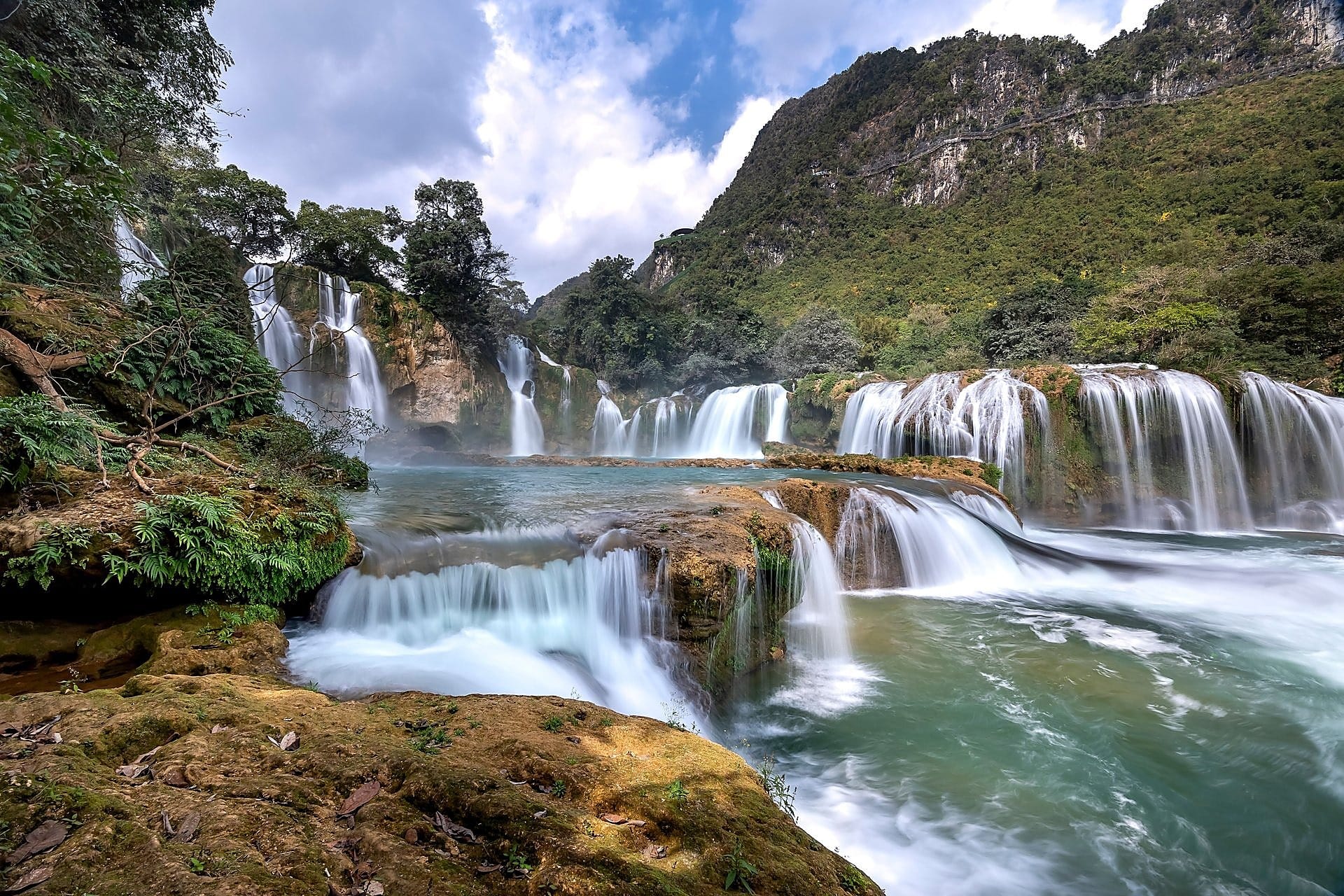
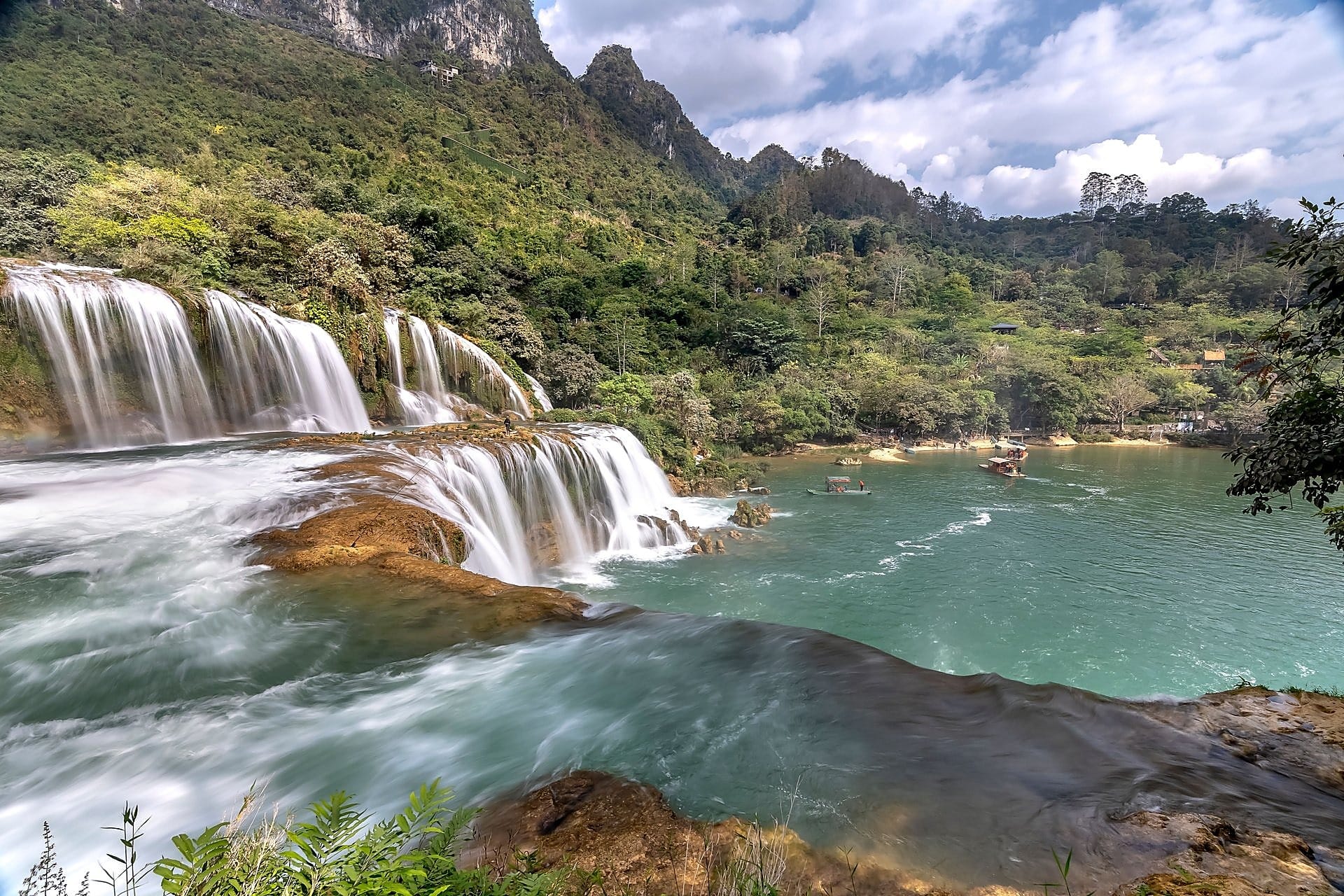
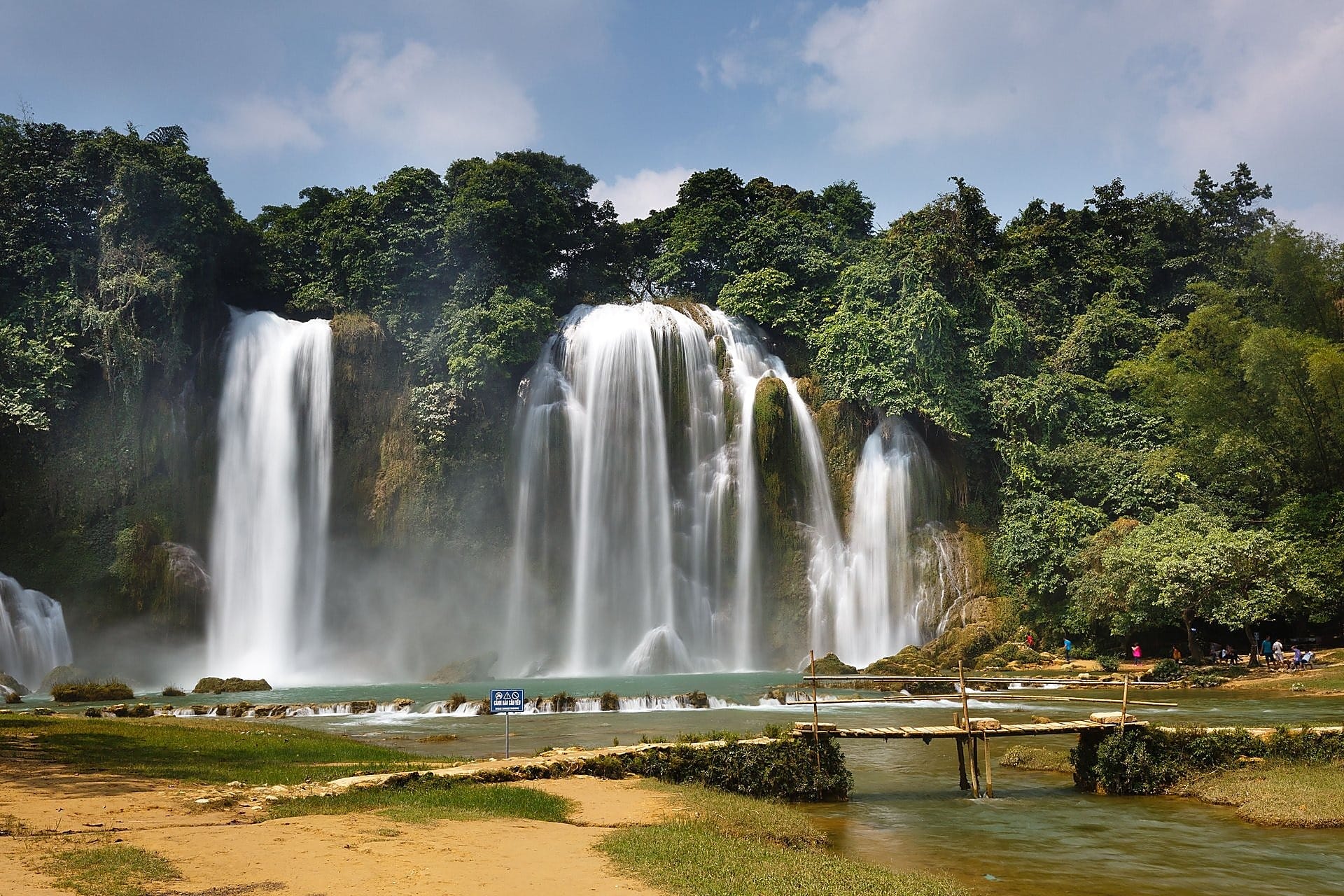
Short answer: Ban Gioc is Vietnam's widest waterfall, a 30-metre-tall, 300-metre-wide curtain of water on the Quay Son river that Vietnam shares with China. It looks spectacular in September and October, when the summer rains have filled the river. It looks like a row of thin trickles from February to April, when it has not rained in months. Time the visit for the flow, not the calendar.
•Best months: September to early October, full flow plus gold rice terraces.
•Worst months: February to April, low-flow dry season when the falls almost disappear.
•From Hanoi: about 335 km northeast, 7 to 8 hours by road. Not a same-day return trip. Plan 3 days.
Quick Facts
Ban Gioc Waterfall (Thac Ban Gioc)
What
Vietnam's widest waterfall, shared with China across a border river
Height
30 metres, three tiers
Width
Around 300 metres at full flow
Where
Quay Son river, on the Vietnam-China border, Cao Bang province
Distance from Hanoi
About 335 km northeast, 7 to 8 hours
Distance from Cao Bang city
85 km, about 2.5 hours
Entry ticket (reference)
~45,000 VND adult from 1.3 m; ~20,000 VND for 1 m to 1.3 m; free below 1 m
Bamboo raft (reference)
~50,000 VND per person, 10 to 15 minutes
Opening hours
07:30 to 17:00 daily, including public holidays
Best months
September to early October
Recognition
Part of the Non Nuoc Cao Bang UNESCO Global Geopark, listed 2018. Named by Travel + Leisure in 2021 as one of the 25 most beautiful waterfalls in the world
Note on prices: every VND figure here is a reference. Rates change with season, group size and operator. Confirm at the ticket office or with your operator before booking.
Why the Flow Season Matters More Than the Weather
Most guides talk about the best weather at Ban Gioc. That is the wrong question. The real question is whether the waterfall is full or empty when you arrive.
The Quay Son depends on monsoon rain. It fills through the summer wet season from June to August, runs strongest in September and early October, then drains through the winter. By March the river is low and the waterfall becomes four or five thin ribbons running down bare rock.
Month
River flow
Rice terraces
Sky
Verdict
Jun-Aug
Rising fast, often muddy brown
Green, just planted
Rainy
Strong but muddy, hard to predict
Sep
Peak flow, still clear
Ripening green-gold
Mostly clear
Best month overall
Oct
Full but starting to drop
Harvest gold, roughly a two-week window
Clear
Second best
Nov
Full, cooler and clearer light
Post-harvest
Great for photos, cooler
Dec-Jan
Half flow, cold air
Bare stubble
Grey, misty
Falls look thin
Feb-Apr
Low flow, thin ribbons
Bare or ploughed
Foggy
Do not travel for this
May
Rising, patchy
Newly planted
Warming
Wait for the rains
One warning for the peak months. Heavy monsoon rain can turn the Quay Son brown and cloudy for a week or two at a time. If you want the clear jade-green water from the famous photographs, aim for late September through early November, after the biggest storms have passed.
Getting There from Hanoi
Ban Gioc is far. This is not Sapa or Ha Long Bay, not somewhere you can pop up to for a day. Cao Bang province sits against the Chinese border, and the falls are another 85 km beyond Cao Bang city.
Prices below are reference only.
Route
Total time
Cost per person (reference)
Best for
Sleeper bus Hanoi to Cao Bang, then onward transport
7-8 hr bus plus 2.5 hr
~170,000-250,000 VND for the bus
Budget travellers
Limousine van direct to Cao Bang
7-8 hr
Higher than the sleeper bus
Comfort, still slow
Private car with driver, 3-day round trip
3 days
Priced per car, split among the group
Groups of 3 to 4
Motorbike loop
4-5 days
Bike rental plus petrol
Experienced riders only
From Cao Bang city to the falls, you do not have to rent anything. Local bus routes 03 and 07 run from Cao Bang bus station to Ban Gioc, which is the cheapest option and the one most independent travellers miss. A rented car or motorbike buys you the freedom to stop at Ma Phuc pass and Nguom Ngao on the way, which is the main reason to pay more.
The realistic itinerary is 3 days, 2 nights:
•Day 1: overnight bus from Hanoi to Cao Bang city, leaving around 9pm and arriving around 5am.
•Day 2: on to Ban Gioc, about 2.5 hours. Waterfall plus Nguom Ngao Cave. Sleep near the falls or back in Cao Bang city.
•Day 3: return to Cao Bang and take the evening bus back to Hanoi.
A same-day trip from Hanoi is not realistic. You would drive 16 hours or more for perhaps 2 hours at the falls.
What the Site Actually Looks Like
The Vietnamese-side viewpoints
The main site is a grassy meadow at river level, opposite the falls and about 200 metres from the base. Four stops, in order:
•Main viewpoint, the river meadow. Ground-level view of all three tiers. Best for the wide postcard photo.
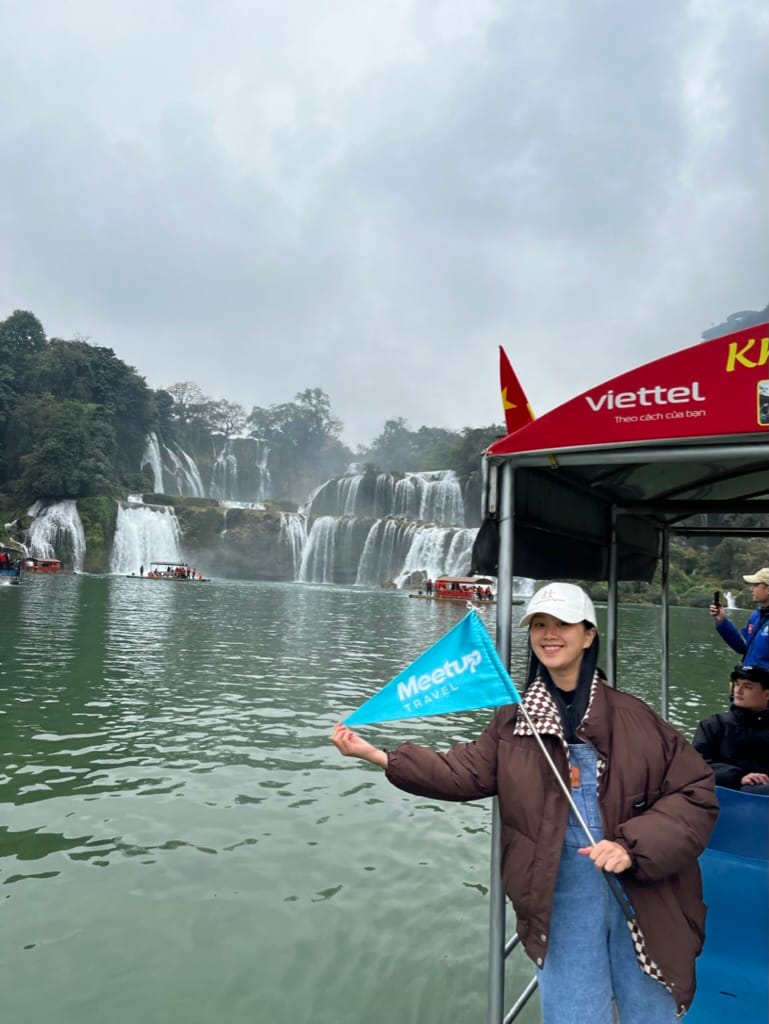
•Bamboo raft ride. Ten to fifteen minutes on a raft that reaches about 40 metres from the base. You will get wet from the spray even in the dry season, so bring a cover if your camera is not waterproof.
•Border marker 836. The stone marker of the Vietnam-China border on the riverbank. A quick photo stop.
•Truc Lam Ban Gioc Pagoda. A modern Buddhist temple on the hill above the falls, opened in the mid-2010s. A twenty-minute walk up gives the highest view over the whole waterfall and both sides.
Allow 2 to 3 hours to see all four properly. The site is open 07:30 to 17:00 daily, including public holidays, and the rafts usually stop before closing time, so arrive by 3pm at the latest.
The Chinese side and cross-border tourism
The Chinese half is called Detian. Vietnam and China have shared management under a 2015 agreement, and a trial cross-border tourism area opened in October 2023:
•Vietnamese and Chinese passport holders can cross to the other side on a one-day permit arranged at the entrance.
•Holders of any other passport cannot cross without a full China visa and separate arrangements.
•The Chinese side has more built infrastructure, including glass walkways and higher platforms. The Vietnamese side is closer to the base and has the bamboo rafts.
Rules here have shifted before, so check the current position close to your travel date. Most international visitors stay on the Vietnamese side, which is where the classic photographs are taken anyway.
What to pair with Ban Gioc
Ban Gioc alone is a 2 to 3 hour visit. The area is worth a full day if you add:
•Nguom Ngao Cave, 4 km from the falls. A walk through a limestone cave with unusual rock formations, 45 minutes to an hour. Around 40,000 VND for adults and 20,000 VND for children.
•Phong Nam Valley, 10 km south, with rice terraces and Tay ethnic villages. Small homestays available.
•Ma Phuc Pass viewpoint, halfway back to Cao Bang city, the hairpin road view over the karst valley.
•Kim Dong memorial, 20 km from the falls, for anyone interested in the history.
Practical Information
Topic
Details
07:30 to 17:00 daily, including public holidays. Rafts stop earlier. Arrive by 3pm.
What to wear
Layers, since it is sunny at midday and cool near the water. Non-slip shoes for the river meadow; sandals are not ideal. A waterproof layer for the raft.
Camera
Spray reaches the viewpoint on high-flow days. Bring a rain cover or dry bag.
Cash
Bring cash. Vendors, raft operators and the pagoda generally do not take cards. Small notes help.
Food
A few basic restaurants near the entrance. Local Tay specialities include roast duck (vit quay 7 vi) and khau nhuc pork.
Where to stay
Homestays in Trung Khanh, about 5 km from the falls, are closest. Cao Bang city has more hotels but is 85 km away.
Drones
Drones need permission near the border. Casual flying at the falls has led to equipment being confiscated.
Administrative note. Cao Bang province was not merged in the 2025 reform and keeps its name and boundaries. What used to be Trung Khanh district is now Trung Khanh commune under the new two-level structure. The site itself is unchanged.
What Most Guides Do Not Tell You
The famous aerial photo is a drone shot. The classic image showing the Chinese pagoda in the background is almost always taken from the air. From ground level you cannot fit the full width of the falls into one frame.
Weekends are much busier than weekdays. Ban Gioc draws Vietnamese photographers and families, and September and October weekends are the peak of that. A weekday visit is a noticeably different experience.
The falls are one stop in a much larger geopark. The Non Nuoc Cao Bang UNESCO Global Geopark, listed in 2018, covers a wide sweep of karst landscape, and Ban Gioc is one of many sites inside it. If you have come this far north, spend an extra day on the geopark loop rather than turning straight around.
In Short
Ban Gioc is worth the long drive, if the season is right. Excellent in September and October, good in November, and disappointing for roughly six months of the year when the river is low.
Book around the water, not the weather. A sunny February day at Ban Gioc gets you clear skies and a waterfall too thin to photograph. A cloudy September morning gets you the full 300-metre wall of water that makes the drive worth it.
Three days round trip from Hanoi. One day at the falls plus one nearby stop. That is the shape of a good Ban Gioc visit.
Frequently Asked Questions
What is the best time to visit Ban Gioc waterfall?
How do I get to Ban Gioc waterfall from Hanoi?
How much does it cost to visit Ban Gioc waterfall?
Can you cross to the Chinese side of Ban Gioc waterfall?
How long should I spend at Ban Gioc?
Table of contents
•Quick Facts
•Why the Flow Season Matters More Than the Weather
•Getting There from Hanoi
•What the Site Actually Looks Like
•The Vietnamese-side viewpoints
•The Chinese side and cross-border tourism
•What to pair with Ban Gioc
•Practical Information
•What Most Guides Do Not Tell You
•In Short
You show up — we handle everything. 30-minute fix guarantee, insurance included, and a real person always a message away.